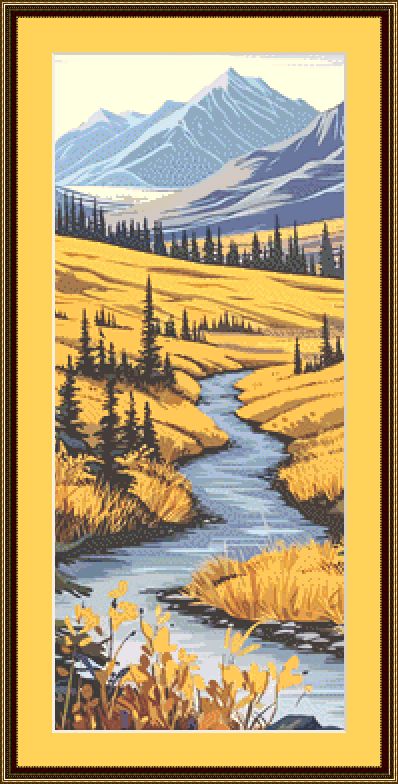
The chart is based on a travel poster and shows a tall, narrow landscape composition built around a winding stream that starts near the lower edge and moves back through the center toward distant water and mountains. It is based on the Kobuk Valley National Park in Alaska. The scene uses a limited palette with strong contrast between pale blue water, golden ground, dark tree shapes, and blue-gray mountain forms.
In the foreground, the stream occupies the center and lower half of the chart. Its surface is rendered with bands of light blue, medium blue, gray-blue, and white highlights that suggest shallow movement and reflected light. On both sides of the stream sit rounded banks filled with yellow and gold grasses. Near the lower left corner, there is a dense cluster of plants and stems rising upward, with leaf and flower shapes in cream, gold, tan, and brown. Dark horizontal stitches near the waterline indicate small shadows or exposed ground at the edge of the stream.
The middle ground contains broad rolling tundra or meadow sections in warm yellow and gold. These areas are broken by curved contour lines and darker stitched accents that define slope, drainage, and changes in ground level. Scattered across these fields are many narrow conifer forms. Some stand alone, while others form grouped lines that mark ridges and distant edges of land. The trees are stitched in dark navy, charcoal, and muted purple-gray, which gives them a strong silhouette against the lighter land.
A band of distant water appears left of center below the mountains. It is pale and reflective, with white and light blue sections that separate the land from the mountain base. Behind and above this water rises a mountain range that fills the upper portion of the chart. The mountains are composed of layered blue, slate, lavender-gray, and white sections. The tallest peak sits slightly right of center. Angular snow lines and light ridges cut across the slopes, creating a poster-like structure rather than a naturalistic painted texture. Smaller peaks extend to the left and right, forming a continuous range.
The sky area at the top is very light, close to cream or pale yellow, with little internal detail. This keeps attention on the landforms. The whole chart relies on clean shape boundaries, directional stitch blocks, and simplified tonal areas rather than fine surface detail. The result is a scenic pattern with a strong vertical flow from flowers and stream in the foreground to tundra, lake, and mountains in the distance.
Within the chart area, the main content elements are:
- a central winding stream
- grassy banks and tundra in yellow and gold
- foreground plants at the lower left
- many dark conifer trees in clusters and rows
- a distant band of water
- a layered mountain range with snow markings
- a pale open sky
This chart contains 75 colors and is 145x338 stitches.
© All Rights Reserved.